

How to Choose the Right Bottling Line Capacity for Your Operation
Selecting the correct bottling line capacity is one of the most important decisions in a 5-gallon bottling operation. Choosing a system that is too small limits growth, while oversizing can strain budgets and floor space.
Bottling line capacity planning requires understanding not just bottles per hour, but labor, facility constraints, sanitation requirements, and future demand. This guide breaks down how to evaluate 150, 250, and 350 bottles per hour (BPH) systems and determine which capacity is right for your business.
Step 1: Understand What BPH Really Means
BPH, or bottles per hour, represents the maximum output of a bottling line under optimal conditions. However, real-world production depends on more than the machine rating.
Factors that affect actual throughput include:
- Operator efficiency
- Bottle handling and staging
- Wash, fill, and cap cycle time
- Downtime for sanitation and maintenance
- Facility layout and workflow
Capacity planning should always consider sustained production, not just peak output.
Step 2: Evaluate Your Current and Future Demand
Before selecting a system size, bottlers should answer three key questions:
- How many bottles do we produce per day today?
- How many bottles will we need to produce in 12 to 36 months?
- Do we plan to expand delivery routes, retail accounts, or private-label production?
Planning only for current demand often results in premature system replacement. Planning for future demand allows the bottling line to scale without disruption.
Step 3: Comparing 150 vs 250 vs 350 BPH Bottling Systems
150 BPH Bottling Systems
A 150 BPH system is typically suited for:
- Start-up bottlers
- Small water stores
- Facilities with limited space
- Operations producing lower daily volumes
Advantages:
- Lower initial investment
- Compact footprint
- Suitable for limited production schedules
Limitations:
- Limited ability to scale
- Longer production shifts to meet growing demand
- Higher labor impact as volume increases
A 150 BPH system can work well initially, but often becomes a bottleneck as demand grows.
250 BPH Bottling Systems
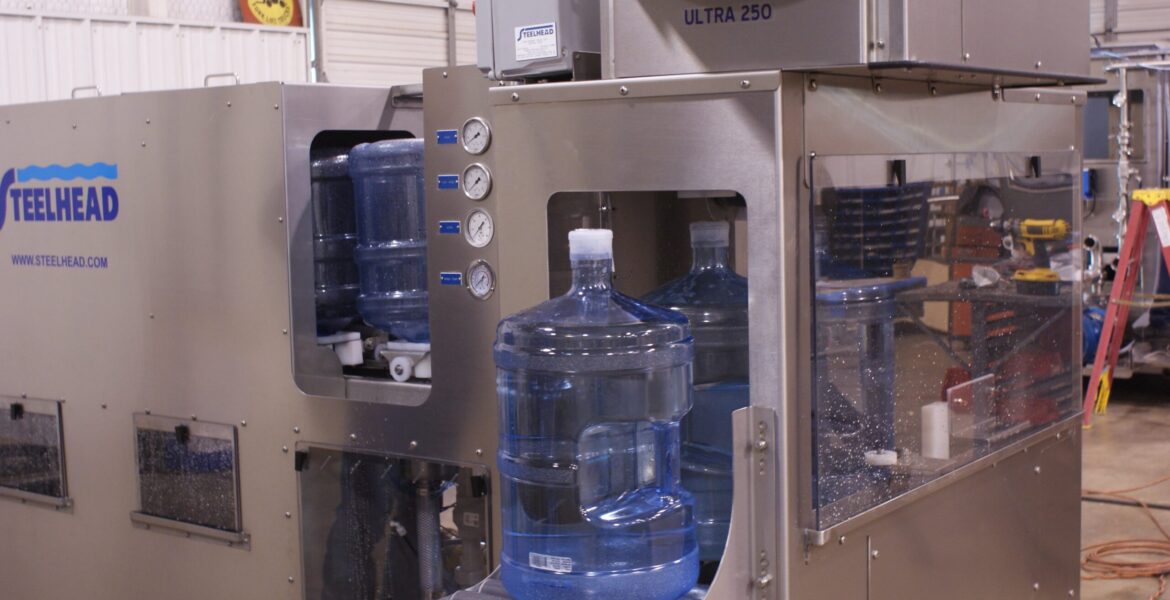
A 250 BPH system represents a balance between capacity and efficiency.
Best suited for:
- Growing bottled water businesses
- Culligan and water service dealerships
- Operations adding routes or accounts
Advantages:
- Strong daily output without excessive footprint
- Single-operator capability
- Improved efficiency compared to entry-level systems
- Better long-term value for expanding operations
Limitations:
- May reach capacity if rapid growth occurs
- Less buffer for peak demand than higher-capacity systems
For many bottlers, 250 BPH is the most practical starting point for sustainable growth.
350 BPH Bottling Systems
A 350 BPH system is designed for operations that require high throughput and scalability.
Ideal for:
- Established bottlers
- High-volume delivery operations
- Facilities replacing older or slower equipment
- Businesses planning aggressive growth
Advantages:
- High output with single-operator workflow
- Shorter production shifts
- Greater flexibility to absorb demand spikes
- Strong return on investment as volume increases
Considerations:
- Higher upfront investment
- Requires proper facility layout and planning
For bottlers with clear growth trajectories, a 350 BPH system often delivers the lowest cost per bottle over time.
Step 4: Consider Labor and Operational Efficiency
Labor is one of the largest operating costs in bottling operations. Higher-capacity systems do not necessarily require more staff.
Modern bottling lines are designed to:
- Wash, fill, and cap bottles in a single automated process
- Operate with one operator per cycle
- Reduce manual handling and fatigue
In many cases, upgrading capacity reduces labor cost per bottle rather than increasing it.
Step 5: Match Capacity with Facility Constraints
Floor space, ceiling height, utilities, and workflow all influence which system capacity is feasible.
Key considerations include:
- Available production space
- Bottle staging and storage areas
- Access to water, drainage, and power
- Sanitation and air quality requirements
Capacity planning should always include a facility layout review to avoid costly reconfiguration later.
Step 6: Plan for Sanitation and Compliance
Higher output must not compromise sanitation. Bottling lines should maintain consistent wash cycles, controlled fill environments, and reliable sterilization regardless of capacity.
Systems with integrated sanitation features help maintain compliance as production increases.
How Steelhead Supports Capacity Planning Decisions
Steelhead, Inc. works with bottlers to evaluate current operations, forecast demand, and select the correct bottling line capacity. Rather than pushing a single system size, Steelhead focuses on long-term operational success.
Steelhead provides:
- Production and capacity analysis
- System sizing recommendations
- Facility layout support
- Scalable bottling solutions from 150 to 350 BPH
- Equipment designed for single-operator efficiency
This consultative approach helps bottlers avoid undersizing or overspending.
Choose the Right Capacity with Confidence
Bottling line capacity planning is not just about speed. It is about efficiency, scalability, and long-term cost control.
If you are deciding between 150, 250, or 350 BPH bottling systems, Steelhead, Inc. can help you make the right choice based on your operation and growth goals.Call 866-303-3628 or visit steelheadinc.com to speak with a bottling system expert and get guidance tailored to your business.