

A Buyer’s Framework for Selecting the Right System the First Time
Water treatment skids are critical infrastructure for bottling plants, beverage manufacturers, laboratories, and industrial facilities. Choosing the wrong system can lead to poor water quality, excessive downtime, high operating costs, and premature replacement.
This guide outlines the key specifications you should evaluate when buying a water treatment skid, so you can select a system that meets today’s needs and supports long-term operation.
Step 1: Required Flow Rate and Demand Profile
The first and most obvious specification is flow rate, typically measured in gallons per minute (GPM). However, many buyers stop here and miss important context.
You should evaluate:
- Peak flow demand vs average demand
- Continuous operation vs batch operation
- Future capacity expansion plans
- Simultaneous users or processes
A skid designed only for current average flow often becomes undersized as production increases.
Step 2: Recovery Rate and Efficiency
Recovery rate determines how much feed water is converted into usable product water. Low recovery increases wastewater volume, operating costs, and environmental impact.
Key considerations include:
- Target recovery percentage
- Impact of source water quality on recovery
- Ability to maintain recovery under variable conditions
- Tradeoff between recovery and membrane life
Well-engineered systems balance efficiency with long-term reliability rather than pushing recovery at the expense of uptime.
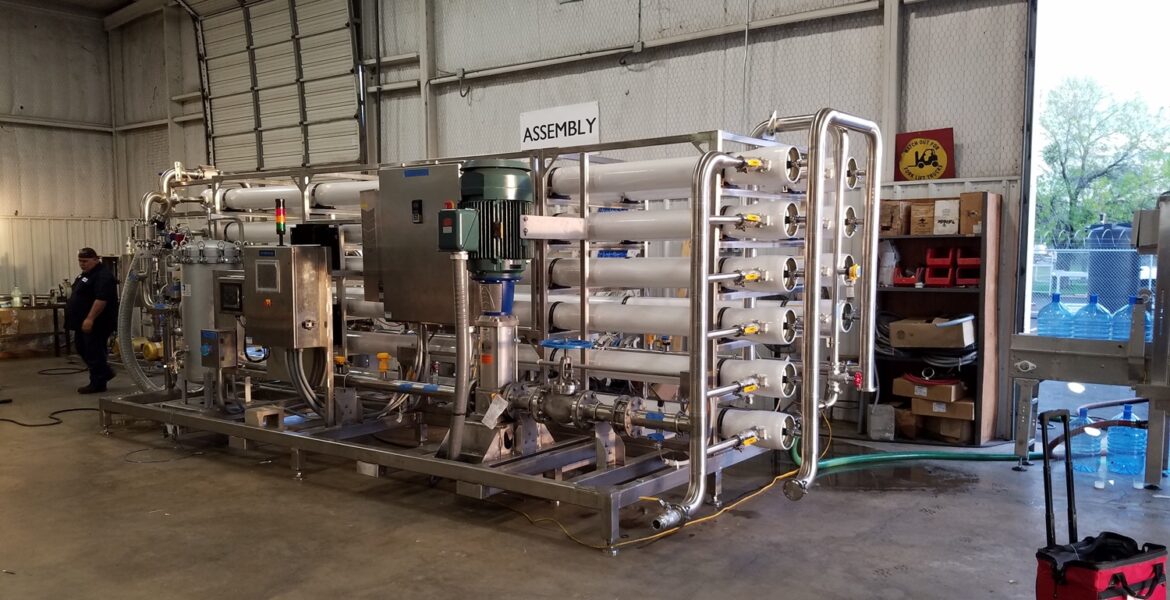
Step 3: System Construction and Materials
The materials used in a water treatment skid directly affect sanitation, durability, and regulatory compliance.
Important material specifications include:
- Stainless steel vs plastic piping
- Sanitary tubing and fittings
- Weld quality and surface finish
- Chemical compatibility with cleaning agents
For food, beverage, pharmaceutical, and bottled water applications, sanitary stainless steel construction is often essential.
Step 4: Pretreatment and Protection Components
Pretreatment protects downstream equipment and determines overall system performance.
Evaluate whether the skid includes or supports:
- Cartridge or multimedia filtration
- Carbon filtration for chlorine and organics
- Chemical injection for scale control or pH adjustment
- Pressure and flow protection devices
Inadequate pretreatment is one of the leading causes of membrane fouling and premature system failure.
Step 5: Instrumentation and Monitoring
A modern water treatment skid should provide clear visibility into system performance.
Key instrumentation specs to review:
- Pressure sensors at critical points
- Flow meters for feed, product, and reject streams
- Conductivity monitoring
- pH and temperature sensors where required
These instruments allow operators to identify issues early rather than reacting after performance declines.
Step 6: Controls, Automation, and Remote Access
Control systems determine how easily a skid can be operated, maintained, and optimized.
Important control features include:
- PLC-based automation
- Touchscreen HMI interface
- Alarm management for out-of-range conditions
- Data logging capability
- Secure remote monitoring and access
Remote monitoring allows faster troubleshooting and reduces reliance on on-site intervention.
Step 7: Clean-in-Place (CIP) Capability
Cleaning is unavoidable in water treatment. Systems not designed for efficient cleaning often require extended downtime.
Evaluate whether the skid supports:
- Integrated or compatible CIP systems
- Easy isolation of treatment stages
- Chemical and temperature compatibility
- User-friendly cleaning procedures
CIP-ready designs reduce maintenance time and extend system life.
Step 8: Integration with Downstream Systems
A water treatment skid rarely operates in isolation. It must integrate with bottling lines, process equipment, or storage systems.
Key integration considerations include:
- Interface with ozone or UV disinfection systems
- Compatibility with storage tanks or silos
- Flow and pressure matching with downstream processes
- Control system communication
Poor integration can create bottlenecks even if the skid itself is well designed.
Step 9: Engineering Support and Customization
Many skids are sold as standardized packages, but few facilities have identical requirements.
When evaluating suppliers, consider:
- Will the system be engineered based on your water analysis?
- Can the skid be customized for your application?
- Is engineering support available before and after installation?
Custom-engineered skids often outperform off-the-shelf systems in demanding applications.
How Steelhead Approaches Water Treatment Skid Design
Steelhead, Inc. designs and manufactures water treatment skids using an engineering-first approach. Rather than selling generic packages, Steelhead evaluates each application to determine the right specifications.
Steelhead systems emphasize:
- Sanitary construction
- High recovery with long-term reliability
- Integrated monitoring and controls
- CIP-ready design
- Seamless integration with bottling and process systems
This approach ensures consistent performance in industrial, beverage, and bottled water applications.
Choose a Water Treatment Skid with Confidence
Evaluating water treatment skid specifications goes far beyond flow rate alone. By reviewing recovery, materials, instrumentation, controls, and integration, you can avoid costly mistakes and select a system built to perform.
If you are planning to purchase a water treatment skid, Steelhead, Inc. can help you evaluate specifications and design a system that fits your operation today and in the future.
Call 866-303-3628 or visit steelheadinc.com to speak with a water treatment expert and discuss your requirements.